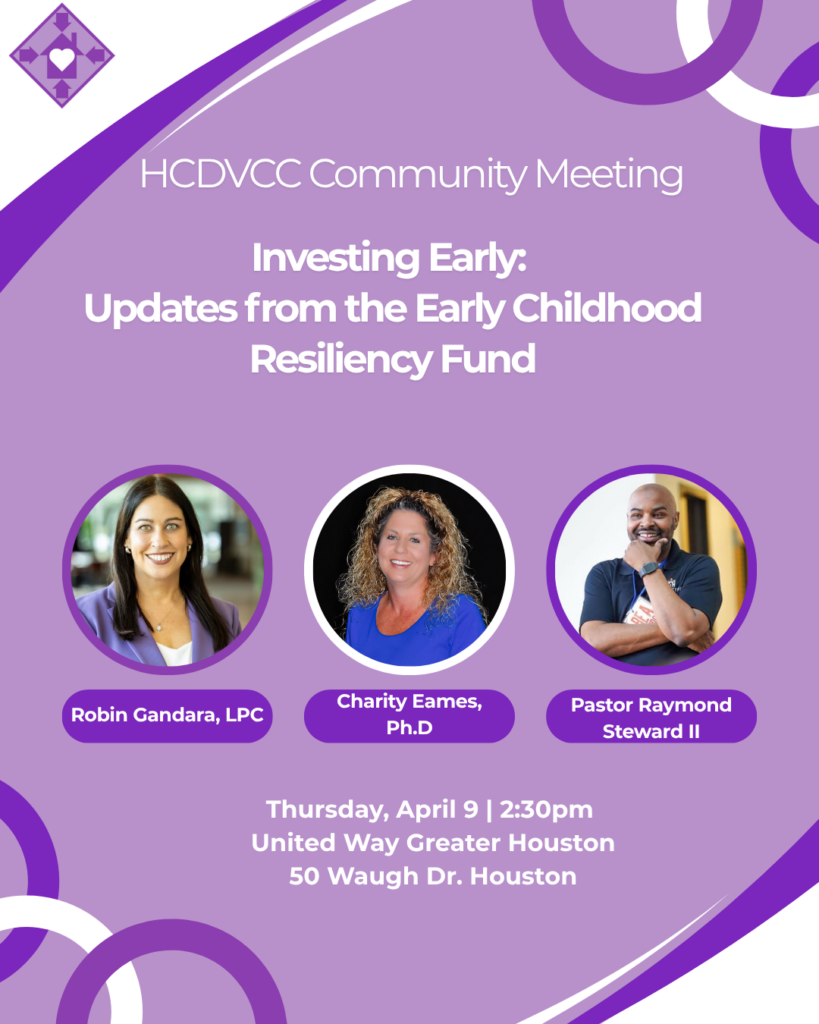
Investing Early: Community Partner Meeting

April 9 @ 2:30 pm 4:00 pm CDT

Early Childhood Resiliency Fund: Community Update & Panel

Join HCDVCC for a community conversation on strengthening early childhood resilience for children exposed to domestic violence.

This session will provide an update on the Early Childhood Resiliency Fund—an investment in local organizations advancing innovative, developmentally responsive support for young children and their families. We’ll hear directly from practitioners about what’s working, where gaps remain, and how early intervention can shift long-term outcomes.

This conversation is designed for professionals across sectors working with children, families, and survivors, as well as those interested in prevention, systems coordination, and community-based solutions.

We’re joined by leaders and practitioners advancing this work across Harris County:

Robin Gandara, LPC
Director of Client Services, FamilyTime Crisis & Counseling Center

Robin Gandara is a Licensed Professional Counselor and Director of Client Services at FamilyTime, where she oversees counseling, shelter operations, case management, outreach, and the 24-hour crisis hotline. Over eight years, she has advanced from counselor to senior leadership, helping shape the organization’s direct service approach.

She led the transformation of FamilyTime’s emergency shelter into a trauma-informed, healing-centered space—redesigning the environment, updating policies to center survivor voices, and expanding programming to better support survivors and their children.

Robin is deeply committed to providing culturally responsive, compassionate care and expanding access to mental health services. She holds a B.S. in Psychology and M.A. in Counseling from Sam Houston State University and is an active member of ACA, TCA, and Harris County SART.

Charity Eames, Ph.D.
Senior Director of Counseling and Family Services, DePelchin Children’s Center

Charity Eames is the Senior Director of Counseling and Family Services at DePelchin Children’s Center, where she oversees counseling, mental health, case management, and parenting support programs. With over 22 years of experience in child abuse prevention, she has worked as a home- and school-based counselor and family therapist supporting children and families.

She provides clinical supervision to staff and leads a range of state and federal grant-funded programs, including initiatives where DePelchin serves as both lead agency and service provider. Charity is trained in nine levels of the Triple P parenting model and brings deep expertise in family-centered, evidence-based care.

Charity holds a Ph.D. in Counselor Education and Supervision and is a licensed counselor and family therapist. Her work is grounded in strengthening families and expanding access to high-quality mental health support for children and caregivers.

Pastor Raymond Steward II
CEO & Founder, Hope Active

Raymond Steward II is the CEO and Founder of Hope Active, a Houston-based organization supporting families and at-risk youth. With over 20 years of experience in community service, leadership, and team building, he launched Hope Active in 2017—following Hurricane Harvey—to create consistent, community-driven support for underserved populations.

He leads initiatives that partner with local schools and juvenile justice programs to connect youth and families with resources, guidance, and opportunities. His work is rooted in the belief that support should be ongoing—not only in moments of crisis—and focused on creating pathways forward.

Raymond’s approach centers on connection, accountability, and community care—offering a hand up, not a handout. His vision for Hope Active is to serve as a bridge between people and possibility, strengthening communities through sustained support.

Free
50 Waugh Street
Houston, TX United States
+ Google Map

March Community Partner Meeting

March 12 @ 2:30 pm 4:00 pm CDT

You’re invited to our Monthly Community Partner Meeting, where community voices come together to shape our shared future.

Topic: The Lived Experience of Women with Initmate partner Violence Accompanied by Mild Traumatic Brain Injury

Intimate partner violence affects 1 in 3 women in their lifetime worldwide. The head and face are the most common targets during intimate partner violences episodes, occurring almost 90% of the time. Of these, approximately half will have symptoms consistent with mild traumatic brain injury, yet only a third of them will seek healthcare services. Even when they do seek services, many mild traumatic brain injuries go unrecognized by clinicians. This leaves this population at risk for experiencing chronic symptoms such as, poor health, back pain, headaches, depression, anxiety, PTSD, insomnia, poor concentration, and emotional dysregulation. While plenty of surveys and screening tools have provided researchers with quantitative data in recent years, no one has asked these women how the mild traumatic brain injury from intimate partner violence has impacted their daily functioning. This presentation will share narratives from the women themselves along with the overall interpretation of the data so that we may be able to better understand their challenges in the aftermath of intimate partner violence.

ABOUT OUR SPEAKER:

Sandra Sanchez, PhD, RN, SANE-A, SANE-P, AFN-C has been a registered nurse for more than 30 years. As the current nursing program director for the Forensic Nursing Program at Harris Health, Sandra leads a team of nurses that care for sexual assault, intimate partner violence, child abuse, elder abuse, and human trafficking. Her practice as a forensic nurse since 2003 has allowed her to care for more than 2,400 victims of violence. She has also testified in court on numerous occasions as an expert in sexual assault and intimate partner violence cases. She received her PhD in Nursing Science in 2025. Her research focuses on the lived experience of women with traumatic brain injury from intimate partner violence patient. Her goal is to improve the overall quality of care to victims and minimize the physical and psychological impact of interpersonal violence by promoting hope, resilience, and restoration of the lives of those afflicted by interpersonal violence.

Free
50 Waugh Street
Houston, TX United States
+ Google Map

February Community Partner Meeting

February 12 @ 2:30 pm 4:00 pm CST

You’re invited to our Monthly Community Partner Meeting, where community voices come together to shape our shared future.

Topic: Immigration & Legal Updates

This presentation will cover an update on law and policy changes impacting immigrant survivors of domestic violence, sexual assault, human trafficking, and other forms of violence over the last year. The training will also briefly include important tools for advocates serving survivors and tips for enhanced safety planning.


ABOUT THE SPEAKER:

Katharina Dechert is the Houston Policy & Advocacy Manager at the Tahirih Justice Center. Katharina leads the advancement of Tahirih’s Houston and Texas advocacy campaigns to change the laws and policies that prevent immigrant survivors from accessing safety and justice. Before stepping into this role, she worked on Tahirih’s legal team for 6 years as a legal advocate, working with immigrant survivors as they navigate various legal systems in their journeys to safety and justice, and representing survivors before USCIS as a DOJ Accredited Representative.

Free

When you register, you’ll be added to our newsletter so you can stay connected and hear about upcoming events and updates.

50 Waugh Street
Houston, TX United States
+ Google Map

If you have questions, please contact:

Categories
Children Community DVAF

Update on the Domestic Violence Assistance Fund

Domestic Violence Assistance Fund-Update

By: Shannon Falk,
Project Manager

As an agency that convenes the community to discover opportunities to improve services, Harris County Domestic Violence Coordinating Council convened a very special meeting of community stakeholders and survivors in 2016 to look at opportunities to expand the menu of services offered for families affected by domestic violence, and to increase victims’ access to services and safety. This discussion was a collective opportunity for our community to think about innovative ways to go beyond the way services were currently being offered. It was also an opportunity to hear directly from survivors about the needs and challenges they faced in the pursuit of safety.

The work of the community stakeholders led to the idea of developing a flexible funding project that could prevent families who experience domestic violence from entering homelessness and reduce the amount of time families need emergency shelter services. This in turn could prioritize increased access to services, meeting basic needs, increased economic stability, and increased safety.

Harris County Commissioners and their staff began meeting with the Harris County Domestic Violence Coordinating Council in the Spring of 2020 to address the increasing challenges for those fleeing domestic violence. Leadership at Harris County recognized that the pandemic would increase the needs of victims of domestic violence, so the Domestic Violence Assistance Fund (DVAF) was established first with CARES ACT funding and later with ARPA funding. Administered by the Harris County Domestic Violence Coordinating Council (HCDVCC), the Domestic Violence Assistance Fund provided flexible financial relief to domestic violence survivors through community-based organizations. The goal of the Fund is to rapidly and thoughtfully aid victims of domestic violence and their families with increasing access to services and improving safety. Organizations can do so by providing basic needs assistance (e.g., food) to reduce food insecurity, flexible emergency assistance to ensure safety from domestic violence, housing emergency financial assistance to limit homelessness, childcare assistance to facilitate continued employment, and daily living supplies and other needs (e.g., personal protective equipment (PPE) and cleaning supplies). Funding for evaluation of the project was included. The first round of funding was evaluated in 2021 and showed that victims who were fleeing had increased access to safety due to the funding that was provided through the Fund.

In 2022, Harris County Commissioners awarded HCDVCC an additional DVAF grant for approximately $4.7 million from ARPA funding to continue the work of the flexible funding project. Building on the success of the ARPA funded project, Harris County Commissioners created a line-item in the general county budget to award HCDVCC $1.5 million to continue the flexible funding DVAF project for all of Harris County. This marked a historic victory for victims of domestic violence to have an intentionally targeted and funded item within the County’s budget. HCDVCC continues to partner with 19 organizations to disperse throughout the County. Many of the organizations that participated in the fund focused specifically and solely on serving domestic violence survivors; however, there is a mix of grass roots organizations helping underserved communities as well as an agency serving human trafficking survivors.
Flexible funding has proven to be a low barrier, quick response approach to helping families with financial assistance that could prevent them from entering the homeless system as well as serving as a tool to help a family become safer. The concept of flexible funding support is being used across the nation by other domestic violence service providers, and it has been evaluated as a proven strategy to improve safety for survivors.

Harris County survivors have been able to use the funds for needs related to childcare, transportation (car repairs, car payments, and gas), utilities (electricity, gas, and phone bills), moving (deposits, furniture, and other moving expenses), and safety (security cameras and ring doorbell systems). In the past, some of these expenses would not have been regarded by participating agencies as “basic needs.” However, the significance of some of those items (security systems) to the well-being and mental health of survivors can be life changing. The top category of assistance provided was for food assistance which accounted for 20% of all disbursements, followed by daily living expenses and rental assistance, with 17% of total disbursements each. It is also worth noting that the research study being conducted by UTHealth has found that many clients receiving DVAF assistance are reporting a greater level of trust in the advocates that they are working with. This is a critical finding that demonstrates this flexible funding is not only helping stabilize the survivors with their immediate needs but also building stronger relationships with the staff and agencies who are assisting them which strengthens their support system and in turn their long-term stability.

In 2024, the Fund served 1,207 households with a total of 3,331 individuals within those households. A total of 2,558 households and 7,317 individuals have been served in 2023-2024. By partnering with community-based organizations (CBOs) throughout the county, the Fund was able to reach a wide range of diverse and marginalized communities.

  • Most survivors had children; 59% of all individuals served were children under 18 years old. This equates to 1,965 children served in 2024 and total of 4,398 children served in 2023-2024.
  • Most clients served were renters (64%) and another 32% were living in a shelter or other/unknown situation, while the minority (4%) were homeowners.
  • The clients served were all low income and below 60% AMI with 50% of survivors having no reported income. Other vulnerabilities included 47% of households considered uninsured, and 20% experiencing homelessness.
  • Most of the survivors served were female (96%); with 3% male survivors served and a remaining 1% who identified their gender as other.

While some of the survivors that were served lived near the DVAF organizations that served them, there were clients who came from almost every zip code in Harris County. Zip codes 77036, 77449 and 77077 were the areas where the greatest number of DVAF distributions occurred. There are a number of partner organizations that are located in the 77036-zip code or in the near vicinity and zip code 77077 is close to this zip code as well. 77449 is located north of I-10 and may be a result of trying to reach clients from the northern part of the county despite having minimal partner agencies there.

HCDVCC believes in the power of evaluation to give us the evidence and information necessary to make good decisions for future program investment. It is the best way to ensure that clients are being served effectively as well as ensure that these program dollars are put to good use. Briefly mentioned earlier, HCDVCC has employed Dr. Leila Wood, Professor and Director of Research and Evaluation, Center for Violence Prevention with the McGovern Medical School at UT Health Houston to design and implement a full evaluation of the DVAF funding. Work has included securing IRB approval, designing of survey instruments and tools, and interviews with participating agencies. Connections with all participating agencies of the Fund were made in August 2024 and the survey link was provided to those agencies to distribute to new clients receiving DVAF assistance. Some preliminary findings include:

Improving Survivor Safety

  • Addressing security concerns (Ring cameras, door locks, other safety technology)
  •  Gain access to housing and transportation that allows survivors to leave harm-doing partners
  • Giving survivors their own financial resources
  • Stabilizing transportation access to criminal justice and safety remedies
  • Pay for legal fees for divorce, custody, or other civil remedies

Increasing Survivor Economic Stability

  •  Increasing housing stability (paying rent, deposits, application fees)
  • Facilitating economic empowerment and stability (job training, education, computers for work at home jobs). Having seed funds to start small business
  • Paying for childcare
  • Transportation (fixing or getting a car) to go to work or school

Improving Survivor Physical and Mental Health

  • Reducing stress
  • Empowering survivors to meet their needs
  • Having resources for food
  • Having funds for appointments, testing, and other medical and MH procedures
  • Funding for medications while awaiting insurance coverage

Stabilizing the Needs of Children

  • Pays for child supplies and basic needs
  • Allows for funds for child mental and physical health needs while insurance is pending

Facilitating Greater Connection and Trust

  • Which means engagement in other helpful services (counseling, legal aid, economic empowerment support)
  • Can reduce feelings of isolation and depression

Reducing Occupational Stress of Advocates

  • Advocates can better meet survivor needs
  • Advocates have more avenues to help people improve their own safety
  • There is a clear process for the program, but it is flexible to both survivor and advocate use

The Harris County DVAF project is serving as a national model for how flexible funding can increase and expand avenues and pathways to safety that are victim-defined and survivor-focused. A recent case study highlighting this work was developed and presented by the National Safe Housing Alliance. This study has been shared with the US Department of Health and Human Services and the Administration on Children, Youth and Families, Family and Youth Services Bureau, in collaboration with the National Resource Center on Domestic Violence. It is a beautiful example of how a community can be creative and focused on meeting the needs of those who have experienced trauma and amplifying how a community can intentionally focus efforts for meeting the needs of BIPOC communities.

Thank you to the Harris County Commissioners and staff members who worked to ensure that this project gained the support and confidence to meet critical needs of our most vulnerable community members. Thank you to the partners who work diligently to find ways to support families in our community. And most importantly, thank you to victims and survivors who show great courage in stepping out to seek assistance, increase safety, and find pathways for healing and hope. We are inspired by your courage and persistence.

Categories
IPV and LGBTQIA Mental Health Awareness Month Sexual Assault

Domestic Violence in the LGBTQIA Community: A Hidden Crisis


June is Pride Month, a time to celebrate the diversity and resilience of the LGBTQIA community. However, it is also an important moment to acknowledge and address the significant challenges faced by this community, including domestic violence. Understanding the unique dynamics and statistics surrounding intimate partner violence (IPV) in the LGBTQIA community is crucial for effective prevention and support.

Statistics and Trends
Domestic violence in the LGBTQIA community is a pervasive issue that often goes underreported and underacknowledged. Nationally, research shows that 43.8% of lesbian women and 61.1% of bisexual women have experienced rape, physical violence, and/or stalking by an intimate partner at some point in their lives. For gay and bisexual men, the rates are 26% and 37.3%, respectively. These rates are significantly higher than those reported by heterosexual individuals, indicating a troubling disparity.

In Houston and Harris County, Texas, the situation reflects broader national trends. Domestic violence homicides have increased sharply in recent years, with intimate partner violence homicides in the area doubling from 32 in 2019 to 64 in 2022. The increase in calls to shelters and domestic violence hotlines also highlights the growing need for resources and support for victims in the region.

Why It Happens
Several factors contribute to the high rates of domestic violence in the LGBTQIA community:

  • Stigma and Discrimination: LGBTQIA individuals often face societal stigma and discrimination, which can isolate them and make it harder to seek help.
  • Lack of Support Services: Many domestic violence services are not equipped to handle the unique needs of LGBTQIA individuals, leading to a lack of accessible and appropriate resources.
  • Internalized Homophobia/Biphobia/Transphobia: Internalized negative beliefs about one’s own LGBTQIA identity can contribute to staying in an abusive relationship.
  • Outing as a Threat: Abusers may threaten to “out” their partners to family, friends, or employers as a form of control.

Who Is More Frequently Affected
Certain groups within the LGBTQIA community are more vulnerable to domestic violence:

  1. Transgender Individuals: Transgender people, particularly transgender women of color, experience disproportionately high rates of violence and homicide.
  2. Bisexual Individuals: Bisexual individuals often face abuse from both same-sex and different-sex partners.
  3. Youth: LGBTQIA youth are at higher risk of experiencing dating violence, often compounded by lack of family support.

Tips for Victims of Intimate Partner Violence

  • Reach Out for Help: Contact local LGBTQIA-friendly domestic violence organizations and hotlines. In Houston, the Montrose Center provides specialized services for LGBTQIA individuals facing domestic violence.
  • Create a Safety Plan: Develop a plan that includes safe places to go, people you can call, and important items to take if you need to leave an abusive situation quickly.
  • Document the Abuse: Keep a record of incidents, including dates, times, and descriptions of the abuse. This can be useful for legal action or obtaining protective orders.
  • Seek Legal Protection: Obtain a protective order if necessary. Legal services are available to help navigate this process.
  • Therapy and Support Groups: Engage in therapy or support groups that cater to LGBTQIA individuals to receive emotional support and validation.

Addressing domestic violence in the LGBTQIA community requires a multifaceted approach that includes increasing awareness, improving access to resources, and fostering an environment where victims feel safe and supported to seek help. During Pride Month, and beyond, it is essential to continue advocating for the rights and safety of all individuals within the LGBTQIA community.

For more information on resources and support in the Houston area, you can visit the Montrose Center’s website.

Categories
Mental Health Awareness Month

The Invisible Wounds: How Domestic Violence Leaves Lasting Scars on Mental Health

Domestic violence doesn’t end when someone escapes. Even after the bruises fade and the locks are changed, the impact lingers—especially on mental health. For survivors, the trauma of abuse can be a quiet, constant companion that affects how they think, feel, connect, and function every day. During Mental Health Awareness Month, it’s important to recognize that for many survivors, healing is not just physical—it’s emotional and psychological too.

Abuse Isn’t Just Physical—It’s Psychological

Domestic violence often includes more than physical harm. It can be emotional, verbal, financial, and psychological. Survivors are frequently told they’re worthless, isolated from support systems, stalked, threatened, or financially controlled. Over time, this can completely erode a person’s sense of self and safety.

According to the National Center on Domestic Violence, Trauma & Mental Health, survivors of domestic violence experience higher rates of depression, anxiety, PTSD, and suicidal thoughts than the general population. These mental health struggles are not signs of weakness—they’re normal responses to prolonged trauma.

“One of the most harmful impacts of abuse is the way it changes how survivors see themselves and the world around them,” says the center.

The Long Road to Recovery

Many survivors live with Post-Traumatic Stress Disorder (PTSD), even years after leaving an abusive partner. Flashbacks, nightmares, hypervigilance, and avoidance behaviors can make everyday life exhausting. Others experience depression, feeling numb, hopeless, or disconnected. Anxiety—about safety, relationships, money, or parenting—is also common.

Some survivors also turn to coping mechanisms like substance use or self-isolation, which can further complicate their recovery.

And yet, mental health support is not always easy to access. For many, the stigma of both domestic violence and mental health struggles keeps them silent. Others face barriers like cost, lack of culturally relevant services, or fear of not being believed.

What Survivors Need Most

Mental health care for survivors needs to be trauma-informed and survivor-centered. That means providers must understand the dynamics of abuse and avoid re-traumatizing the person. Therapy should help survivors regain control over their lives, not shame them for their symptoms.

Support from friends, family, and community also plays a huge role. Just listening without judgment, validating a survivor’s experience, or helping them access resources can make a difference.

As we mark Mental Health Awareness Month, it’s important to remember – healing doesn’t happen on a timeline. Survivors need space, patience, and support.

If you or someone you know is experiencing domestic violence, confidential help is available. Call the National Domestic Violence Hotline at 800-799-7233 or visit www.thehotline.org.  Or you can visit one of these for Mental Health assistance:

This is a 24/7 confidential resource for individuals in suicidal crisis or emotional distress. You can call or text 988, or chat online at 988lifeline.org

A 24-hour, confidential service for veterans and those who support them, even if they are not enrolled in VA healthcare. You can connect by calling 988, then pressing “1”, or by texting 838255. 

A statewide network connecting individuals with local resources and information, including mental health support. You can call 2-1-1, or dial 2-1-1 option 8 for behavioral health support. 

Provides information on state-funded crisis services and mental health authorities in your county. You can search for local mental health authorities by entering “mental health crisis” along with your ZIP code. 

A confidential and anonymous resource for mental and substance use disorders. 

A website that provides information about treatment facilities and resources for mental and substance use disorders. 

A grassroots organization dedicated to building better lives for individuals affected by mental illness, offering support, education, and advocacy. 

Sources:

Categories
Teen Dating Violence Awareness Month

Teen Dating Violence Awareness Month

teen female looking at phone, stressed with the title of the article on the side (Teen Dating Violence Awareness Month: What to Look For & How to Help).

Teen Dating Violence Awareness Month: What to Look For & How to Help

Teen relationships should be fun, safe, and built on mutual respect. But for too many teens, dating turns into something dangerous—something that hurts instead of uplifts. February is Teen Dating Violence Awareness Month, a time to shine a light on an issue that affects 1 in 3 teens in the U.S. If you’re in an unhealthy relationship, know someone who is, or just want to be prepared to support a friend, keep reading.

Spotting the Signs of an Unhealthy Relationship

Teen dating violence isn’t just physical. It can be emotional, psychological, digital, sexual, or financial abuse. The person being abused may not even realize what’s happening at first. Here’s what to look for:

  • Extreme jealousy or possessiveness – A partner who constantly checks your phone, gets mad if you talk to others, or accuses you of cheating without reason.
  • Controlling behavior – They tell you who you can and can’t hang out with, what to wear, or how to act.
  • Love bombing, then withdrawal – At first, they’re over-the-top sweet, texting nonstop, giving gifts, making big promises. Then they pull away, punish you with silence, or make you feel like you’re “too much.”
  • Embarrassing or humiliating you – Making fun of you in front of others, calling you names, or spreading rumors.
  • Threats or intimidation – Saying they’ll hurt themselves if you leave, threatening to ruin your reputation, or using fear to control you.
  • Physical harm – Pushing, hitting, throwing things, or any kind of physical violence—even just once.
  • Digital abuse – Hacking into your accounts, demanding passwords, sending unwanted explicit photos, or tracking your location.

Red Flags That Shouldn’t Be Ignored

🚩 They rush the relationship and say things like, “I’ve never felt this way before” within days or weeks.
🚩 You feel like you have to walk on eggshells around them.
🚩 They pressure you into things you’re uncomfortable with—whether it’s sex, drugs, or skipping school.
🚩 They make you doubt yourself—gaslighting you into thinking you’re overreacting or imagining things.
🚩 They isolate you from your family and friends, making you dependent on them.
🚩 You feel afraid to leave because you don’t know what they’ll do.

How to Help a Friend in an Abusive Relationship

If you notice a friend pulling away, acting different, or making excuses for their partner’s toxic behavior, they may be in an abusive relationship. It’s not always easy to get through to them, but here’s what you can do:

  • Believe them. If they open up, listen without judgment. Don’t minimize their experience by saying, “It’s probably not that bad.”
  • Avoid blaming them. They may not leave right away, and that’s okay. Instead of, “Why don’t you just break up?” try, “I’m here whenever you need me.”
  • Help them see the signs. Gently point out concerning behaviors. “I’ve noticed your partner always checks your phone. Does that make you uncomfortable?”
  • Stay connected. Abusers isolate their victims. Keep inviting your friend to hang out and check in often.
  • Offer a way out. Help them make a safety plan (more on that below) or offer to go with them to talk to a trusted adult.

Getting Out of an Abusive Relationship

Leaving isn’t easy, especially when emotions are involved. But safety comes first. Here’s how to make an exit plan:

Talk to someone you trust – A parent, school counselor, teacher, coach, or friend. You don’t have to do this alone.
Plan your breakup in a safe place – If you’re afraid of their reaction, break up in a public place or over text. Do not meet alone.
Block them on social media and your phone – This prevents them from harassing or manipulating you after the breakup.
Gather evidence – If they’ve been threatening or abusive over text, save screenshots. You may need them later.
Know your escape route – If they show up at your school or house, have a plan on where you’ll go and who you’ll call.
Get professional helpLove Is Respect (866-331-9474) and The National Domestic Violence Hotline (800-799-7233) have 24/7 support.

You’re Not Alone – Support Is Out There

No one deserves to feel unsafe in a relationship. If you or someone you know is experiencing dating violence, help is available:

💜 Love Is Respect – Call 866-331-9474 or text “LOVEIS” to 22522 for confidential support.
💜 National Domestic Violence Hotline800-799-7233 or chat at thehotline.org.
💜 Talk to a trusted adult – A teacher, coach, school counselor, or family member can help you navigate your next steps.

Dating should feel exciting, safe, and uplifting—never scary or suffocating. If something doesn’t feel right, trust yourself. Help is always available, and you deserve better.

.

Texas Council on Family Violence 89th Legislative Agenda


April 23


@


4:34 pm

Free

50 Waugh Street

Houston,

TX

United States

+ Google Map


Tickets

The numbers below include tickets for this event already in your cart. Clicking “Get Tickets” will allow you to edit any existing attendee information as well as change ticket quantities.

Tickets are no longer available